New Mazda MX-5 Miata RF for Sale Near Summerville, SC


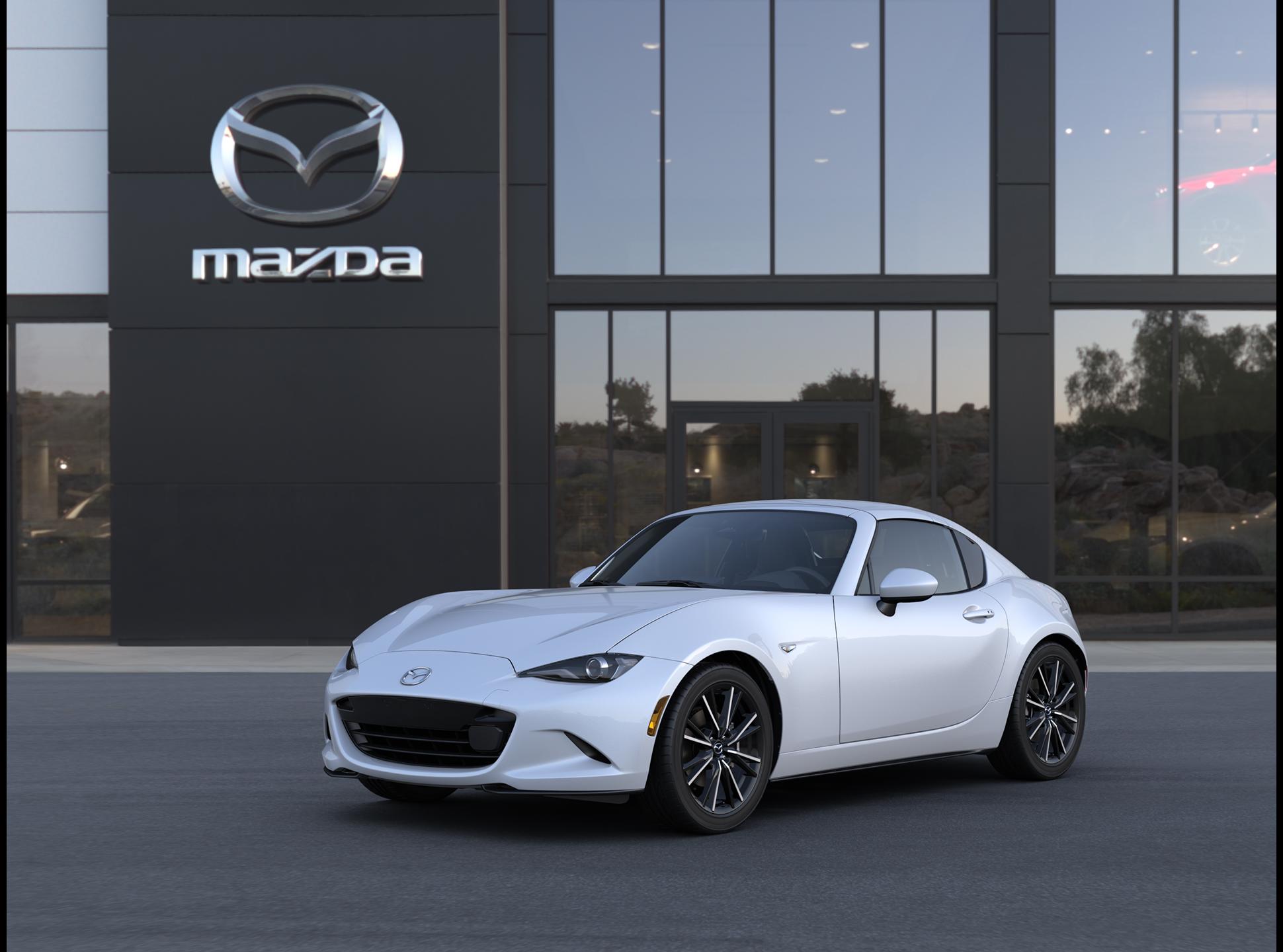

Frequently Asked Questions About the Mazda MX-5 Miata RF near Summerville, SC
What does RF actually stand for?
Retractable Fastback, which describes what the roof does. The center panel and the rear glass tuck themselves away while the pillars behind your shoulders remain, so you get open air without the profile of a full convertible. It is a distinct look, not a variation on the same one. Plenty of buyers choose between the two on appearance alone and are perfectly entitled to.
Is it quieter than the fabric roofed car?
Closed up, noticeably. A rigid panel and glass keep more road and wind noise outside, which is the difference you feel out on an interstate and not on a back road. Anybody planning to commute in one should weigh that heavily. Noise is what makes a small car tiring across distance, far more than ride or seat comfort do.
Can the roof be opened while moving?
At low speed, yes, which is genuinely useful in traffic. It takes a little longer than the fabric roof and it happens at the press of a switch instead of by hand. Try it in the lot so you know what to expect before you need it. Knowing the procedure exists is worth a great deal more than discovering it during a downpour.
Does the folding hardware cost me trunk space?
Less than people assume, because the mechanism stows above the luggage area instead of into it. The trunk is close to the fabric roofed car and neither is generous. Bring your own bag and settle it in the parking lot. The answer differs between the two versions of this car and is worth checking instead of assuming.
Which one should I buy?
It comes down to use. The fabric car carries less weight, fewer parts, and opens faster; the RF keeps more noise out, sits safer when parked, and copes better across a whole year. Take them out one after the other and the decision tends to resolve inside a few miles. Very few people are still undecided once they have driven both on the same morning.
Have Additional Questions?
The RF conversation is nearly always a comparison, and the comparison is with the other MX-5.
Say how you would use it and where it would park, and the choice narrows immediately.
Stokes Mazda has no preference between the two and will lay out both honestly.
What the Retractable Hardtop Changes
The RF takes the same car and gives it a rigid folding roof, and that one change ripples further than you would expect. Closed up it is quieter, more secure, and better insulated against a summer afternoon than fabric will ever be.
Open, it is not quite the same experience as the fabric car. The buttresses behind your shoulders stay in place, so you get sky overhead instead of open air all around, and some people prefer it that way. Others miss the openness immediately, which is why this gets settled in a parking lot rather than in a description.
- A rigid panel and glass keep more wind and road noise outside, and that difference registers most out on an interstate, hardly at all on a country lane
- Wind behaves differently around the cabin with the buttresses in place, and whether you prefer it that way is something only a drive will settle
- Better insulation against a Lowcountry afternoon is a genuine argument here, where the roof ends up spending a fair share of the year closed anyway
The mechanism itself is the other difference. It operates from a switch instead of your shoulder, takes a little longer, and will work at low speed, which is more useful in traffic than it sounds. Dropping the roof at a red light becomes something you do casually instead of something you plan.
Operate the roof yourself several times before deciding anything. How a mechanism feels to use daily is not something anybody can describe for you. It is the part of this car you will interact with most often.
RF or Fabric Roof, and How People Decide
This is the only real question on the page, and the answer splits along use and not along price or taste. Anybody after a pure weekend car usually goes one way, and anybody wanting something usable daily goes the other.
The fabric roof is lighter, simpler, and quicker to drop, and it delivers the more complete open air experience. The RF is quieter, more secure, and considerably easier to justify as something you drive year round.
- Weekend car buyers tend toward the fabric roof while anybody wanting something usable every single day leans toward the folding hardtop instead, and both groups are well served
- Simplicity and lightness sit on one side of this while quietness and security sit on the other, and neither of those lists is objectively better than the other one
- Drive them back to back on the same afternoon, because the difference is easy to feel and close to impossible to work out from photographs
One is not the enthusiast's answer and the other the sensible one. They are two solutions to the same problem, aimed at people who will use the car differently.
Ask Stokes Mazda to line both up and drive them the same afternoon. This is one of the few decisions that genuinely resolves itself in a few miles. Reading comparisons is a poor substitute for sitting in each one.
A Sports Car You Can Use in Bad Weather
The RF exists for people who want the car and also want to drive it in January and in a downpour. A rigid roof changes how a small car feels when the weather turns, and it changes how willing you are to take it out at all.
That counts for more in this climate than it would somewhere reliably dry. Summer storms arrive fast, and being content to sit through one is what turns an occasional toy into something you drive. Fabric copes perfectly well with rain as well, and the difference is how you feel about leaving it parked underneath.
- Ask how the roof operates if the battery is flat, because knowing a manual override exists is worth far more than the times you never need it
- Ask what the roof does to rear visibility when it is folded, since the stowed panel occupies roughly where a rear window would otherwise have been
- Work out where a phone and a coffee actually sit, since a cabin this size turns small storage decisions into something you run into every day of ownership
Commuting is where this version separates itself most clearly. Road noise is what wears a driver down across an hour, and the RF simply lets less of it in. An hour each way is where that gap stops being a detail and starts deciding whether you keep the car.
Drive it on the interstate instead of a back road if commuting is the plan. That is the stretch where the two versions differ most. Quieter roads hide the noise difference almost entirely.
Leaving It Parked
Security is the argument nobody makes in a brochure and everybody makes after a year of ownership. A rigid roof cannot be cut, which changes how you feel about leaving the car somewhere overnight or all day.
For anybody parking on a street, at an office, or in a lot downtown, that peace of mind is a genuine part of what the RF is for. It is not a dramatic difference and it is a persistent one. Persistent matters more across a few years of ownership than dramatic ever manages to.
- A folding hardtop puts weight higher in the car than fabric does, and whether you can feel that is a question only a drive answers
- Ask what the roof is likely to cost to service years from now, because a mechanism operated this often deserves that question before you buy rather than after
- Leaving anything visible in a small car is a poor idea regardless of the roof, so the trunk remains the only sensible place for belongings
It also weathers better when left outside. Fabric is durable and it still ages faster in sun and rain than a painted panel does, and a car parked outdoors year round will show that eventually. Keeping it garaged or covered narrows the gap considerably, and neither option costs much to arrange.
Think about where this car will sit when you are not in it. That single question pushes a fair number of buyers toward the RF. Where a car sleeps matters as much here as how it drives.
Where the RF Fits Around Summerville
The RF suits a specific local pattern well: somebody who wants an enjoyable car and still has to drive it to work. That combination is common here and it is exactly what this version was designed around.
The historic streets downtown are a fair test of any car's dimensions, and a small one has an easy time of it. Parking near the old center on a busy afternoon is one of the few places where a compact footprint beats everything else.
- Ask whether the trunk still takes what you carry with the roof folded away, since the answer differs between the two versions of this car
- Older streets downtown fill quickly once the weather turns, and a short car turns that from a hunt into something you simply stop noticing
- A steady run down I-26 is where the quieter cabin proves itself, and it is the stretch that most local owners end up covering most often
Weekend use has not gone anywhere either. Nothing about the folding hardtop stops the roof coming down on a good morning, and the roads west of town are as inviting in this version as in any other. Losing nothing from the weekends while gaining the weekdays is the whole argument for this one.
Drive the route you actually take to work. If the car survives that test, the weekends look after themselves. Nobody has ever bought one of these and struggled to enjoy a Sunday in it.
Come and work the roof, drive it on your commute rather than a scenic loop, and see whether the harder roof earns its place.